|
In the Cave of Hira
When Prophet Muhammad (peace and blessings
be upon him) was nearly 40, he had been wont to pass long hours in
retirement meditating and speculating over all aspects of creation
around him.
This meditative temperament helped to widen
the mental gap between him and his compatriots. He used to provide
himself with simple food and water and then directly head for the
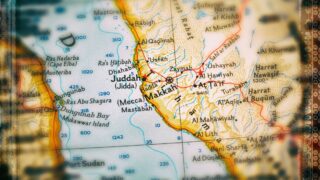
hills and ravines in the neighborhood of Makkah. One of these in
particular was his favorite resort — a cave named Hira, in the
Mount An-Nur. It was only 2 miles from Makkah, a small cave 4 yards
long and 1.75 yard wide. He would always go there and invite
wayfarers to share his modest provision. He used to devote most of
his time, and Ramadan in particular, to worship and meditation on
the universe around him. His heart was restless about the moral
evils and idolatry that were rampant among his people; he was as yet
helpless because no definite course, or specific approach had been
available for him to follow and rectify the ill practices around
him. This solitude attended with this sort of contemplative approach
must be understood in its divine perspective. It was a preliminary
stage to the period of grave responsibilities that he was to
shoulder very soon.
Privacy and detachment from the impurities
of life were two indispensable prerequisites for the Prophet's soul
to come into close communion with the Unseen Power that lies behind
all aspects of existence in this infinite universe. It was a rich
period of privacy which lasted for three years and ushered in a new
era, of indissoluble contact with that Power.
When he was 40, the age of complete
perfection at which prophets were always ordered to disclose their
message, signs of his prophethood started to appear and twinkle on
the horizons of life; they were the true visions he used to
experience for 6 months. In Ramadan, in his third year of solitude
in the cave of Hira, Allah (God) desired His mercy to flow on earth
and Muhammad was honored with prophethood, and the light of
revelation burst upon him with some verses of the Quran.
As for the exact date, careful investigation
into circumstantial evidence and relevant clues point directly to
Monday, Ramadan 21 at night, that is, August 10, 610 CE, with
Prophet Muhammad exactly 40 years, 6 months and 12 days of age, that
is, 39 Gregorian years, 3 months and 22 days.
Aishah, later the Prophet's wife, gave the
following narration of that most significant event in the Prophet's
life:
Forerunners of
the Revelation assumed the form of true visions that would
strikingly come true all the time. After that, solitude became
dear to him and he would go to the cave, Hira, to engage in
devotion there for a certain number of nights before returning
to his family, and then he would return for provisions for a
similar stay. At length, unexpectedly, the Truth (the angel)
came to him and said, "Recite." "I cannot
recite," he (Muhammad) said. The Prophet described:
"Then he took me and squeezed me vehemently and then let me
go and repeated the order 'Recite.' 'I cannot recite' said I,
and once again he squeezed me and let me till I was exhausted.
Then he said, 'Recite.' I said, 'I cannot recite.' He squeezed
me for a third time and then let me go and said [the first
revelation whose meaning can be translated as]
'Read! In the
name of your Lord, Who has created (all that exists), has
created man from a clot (a piece of thick coagulated blood).
Read! and your Lord is the Most Generous.' (Quran 96:1-3)
The Prophet repeated these verses. He was
trembling with fear. At this stage, he came back to his wife,
Khadijah, and said, "Cover me, cover me." They covered him
until he restored security. He apprised Khadijah of the incident of
the cave and added that he was horrified. His wife tried to soothe
him and reassured him saying, "Allah will never disgrace you.
You keep good relations with your kith and kin; you bear the burden
of the weak; you help the poor and the needy, you serve your guests
generously and assist the deserving calamity-afflicted ones."
She set out with the Prophet to her cousin
Waraqa ibn Nawfal, who had embraced Christianity in the pre-Islamic
period, and used to write the Bible in Hebrew. He was a blind old
man.
Khadijah said, "My cousin! Listen to
your nephew!"
Waraqa said, "O my nephew! What did you
see?"
The Prophet told him what had happened to
him. Waraqa replied, "This is the angel who is entrusted with
Divine Secrets that Allah sent to Moses. I wish I were younger. I
wish I could live up to the time when your people would turn you
out."
Muhammad asked, "Will they drive me
out?"
Waraqa answered in the affirmative and said,
"Anyone who came with something similar to what you have
brought was treated with hostility; and if I should be alive till
that day, then I would support you strongly." But after a few
days Waraqa died and the divine inspiration was also paused for a
while.
*Abridged and adapted
from the author's The
Sealed Nectar.
|